We Analyzed 10 Telegram Groups: More Than 1 in 4 Questions Never Get an Answer

Every Telegram group admin has seen it: a member asks a simple question, the chat keeps scrolling, and nobody replies. We wanted to know how often that actually happens, so we measured it.
We read a full work week of messages in 10 public Telegram groups: a top crypto exchange's official English chat, a Web3 airdrop community, a crypto wallet's support group, open-source developer communities and more. Together they have over 500,000 members.
The short version: more than 1 in 4 member questions never got a reply. And when we looked at when those questions were asked, the pattern was hard to miss.
Key findings
- 30% of member questions got no reply at all. That's more than one in four.
- Answers come in minutes or not at all. 51% of questions were answered within 5 minutes. Only 10% got their first reply after 15 minutes or later.
- Questions get lost when the team is offline. In the hours when admins post least, half of all questions went unanswered, almost twice the daytime rate.
- Community-run chats lose twice as many questions as chats where the team answers: 31% vs. 16%. In some community chats, close to half of all questions go unanswered.
- The same questions come back again and again. In the 99k-member chat we followed for a month, 30% of questions had already been asked, and a third of all questions were the same three.
Which Telegram groups we analyzed
We picked 10 active, public, English-speaking Telegram groups across different niches:
- Official English chat of a top crypto exchange: crypto exchange, 330k+ members
- Web3 airdrop campaign community: Web3 / airdrops, 99k members
- Layer-0 blockchain ecosystem community (forum topics): blockchain, 21k members
- Official chat of a blockchain oracle network: DeFi infrastructure, 20k members
- Privacy coin community: open-source crypto, 16k members
- Crypto wallet support group: wallet app support, 10k members
- One of the largest Telegram bot developer communities: developers, 27k members
- Open-source Python library support group: open source, 10k members
- TypeScript bot framework community: developers, 2k members
- Linux distribution community: Linux / open source, 4k members
Half of the list is crypto. That's not a choice we made: it's what active public English groups on Telegram look like. Most of the AI, design and self-hosted "groups" we checked turned out to be broadcast channels or near-silent chats.
How we measured it
- Period: one work week, Monday September 28 – Friday October 2, 2026. Replies were counted through Saturday, so a question asked late on Friday still had time to get an answer.
- Data: around 9,400 messages and 774 member questions, read from public groups. We never posted or joined anything.
- What counts as a question: a member's message phrased as a question (a question mark or "how", "when", "where", "can I"…). Questions from admins and copy-paste spam were excluded.
- What counts as an answer: a Telegram reply to the question from another person. We timed the first reply.
- Repeats: measured over one month in a single 99k-member chat, because a week is too short for questions to come back.
iAll chats in this study are anonymized. We report aggregate numbers only and never quote members by name.
More than 1 in 4 questions never get an answer
Across all 10 groups, 30% of member questions got no reply from anyone: not from an admin, not from another member.
Some of these are casual ("anyone here from Spain?"), but many are exactly the questions a project should care about. In the wallet support group, members asked why a transfer had been stuck for 10 hours, why network fees could no longer be set manually after an update, and why the wallet didn't recognize their transaction. None of those messages got a reply in the chat.
For a new member, an unanswered question is often the whole first impression of your community.
Answer now or never
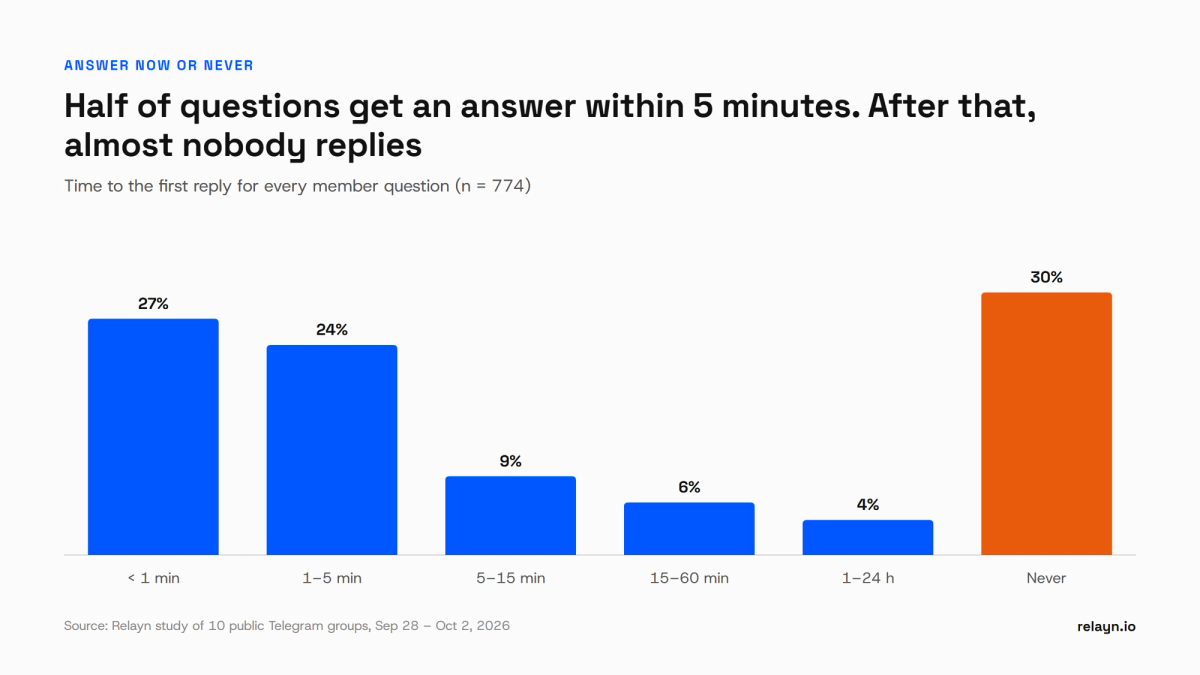
When a question gets an answer, it gets one fast: 51% were answered within five minutes, and the median wait for an answered question was 1–2 minutes in 6 of the 10 groups.
But the window closes quickly. Only 10% of questions got their first reply after the 15-minute mark, and just 4% after an hour. If nobody picks a question up while it's still on screen, it scrolls away under new messages and is almost never answered later.
That's why "we'll get to it later" doesn't work in a busy Telegram group. In practice, later means never.
Questions get lost when the team is offline
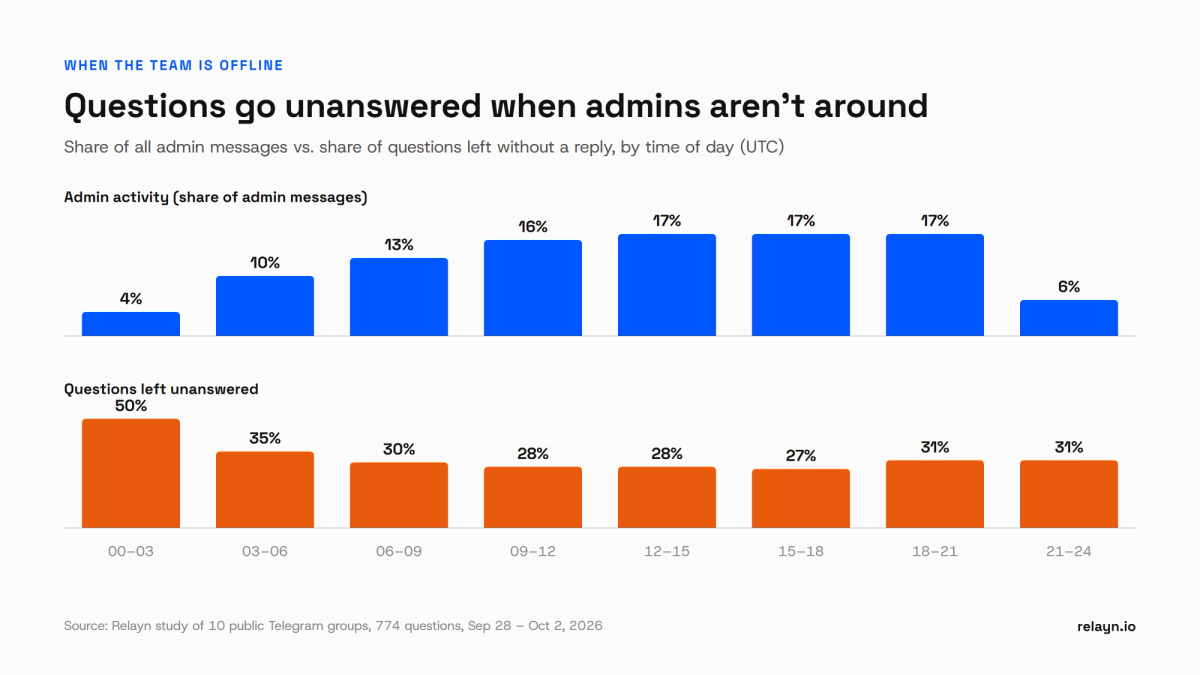
Telegram communities are global. Moderation teams usually aren't.
Between 00:00 and 03:00 UTC, admins wrote just 4% of their messages, and half of all questions asked in those hours went unanswered. During the team's peak hours, the unanswered rate dropped to 27–28%.
The month-long data from the 99k-member chat shows the same thing even more clearly: 63% of questions asked between 00:00 and 03:00 UTC got no reply, against about 23% when the admins were active.
The problem isn't that admins are slow. When they're online, they answer within a minute. The problem is that their working hours rarely line up with the hours their community is awake.
Chats left to the community lose twice as many questions
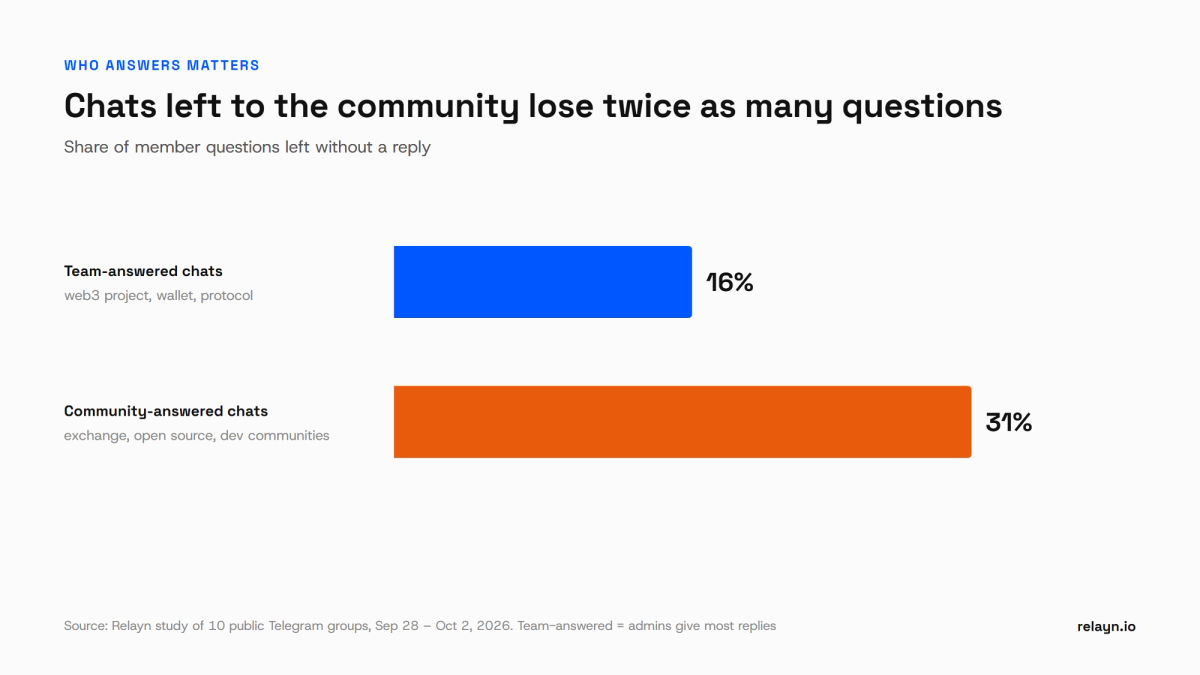
We split the groups by who does the answering:
- Team-answered chats: admins give most of the replies (the Web3 project, the wallet, the oracle network). Here 16% of questions went unanswered.
- Community-answered chats: members answer each other (the exchange, the developer and open-source communities). Here 31% went unanswered, and in the privacy coin community it was close to half.
Community answering scales in a way a small team can't: in the exchange chat, 59 different people answered questions during the week. But "someone will answer" turns out to mean "someone answers most of the time".
Team-answered chats have the opposite weakness. In the Web3 community, three people gave 82% of all answers, and in two of the groups a single admin answered every question. That's fast while they're online, and fragile the moment they're not (see Finding 3).
The same questions, again and again
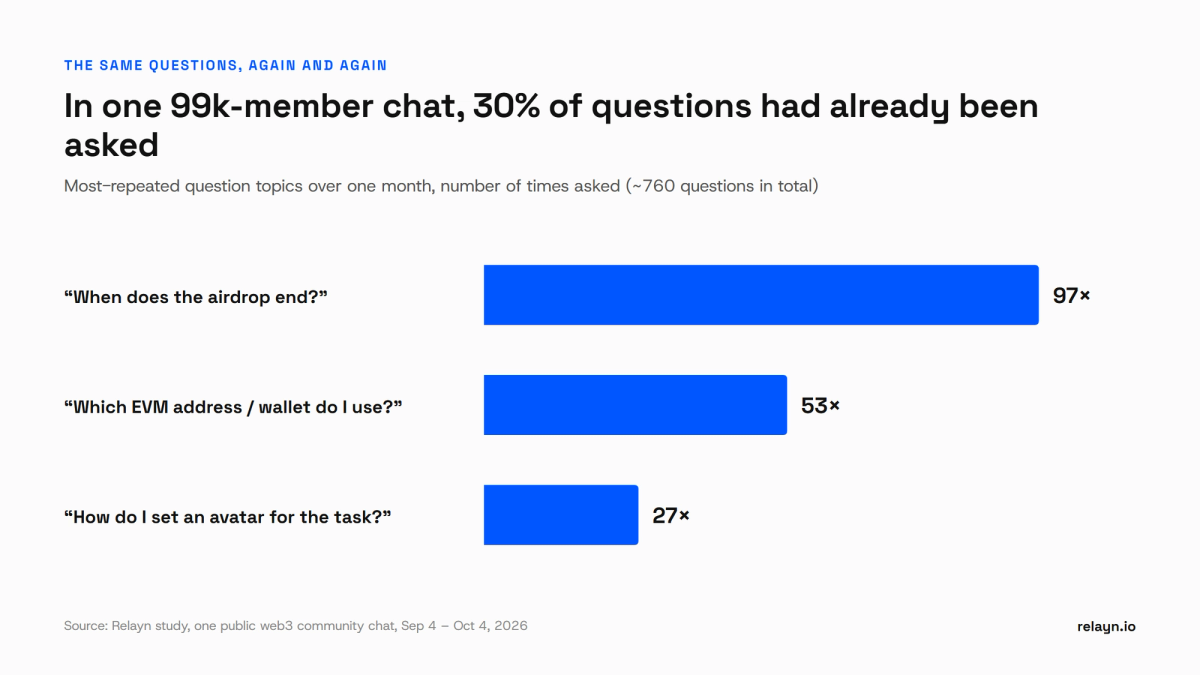
We followed the 99k-member Web3 community for a full month (about 760 member questions). 30% of questions closely matched a question that had already been asked, and a third of all questions were one of just three:
- "When does the airdrop end?" — asked 97 times
- "Which EVM address or wallet do I use?" — 53 times
- "How do I set an avatar for the task?" — 27 times
At some point the admins started answering with "already answered above, please read the chat". That's understandable on the 50th time. But for the member asking, it's their first time, and the answer from yesterday is hundreds of messages up.
What this means for Telegram community managers
1. Cover the hours your team sleeps. Look at when your members are active, not when your team works. If you can't staff those hours, make sure something can answer the common questions while you're offline.
2. Treat the first 15 minutes as the deadline. A question that hasn't been answered in 15 minutes will most likely never be. Fast-but-partial beats complete-but-tomorrow.
3. Don't rely on the community alone. Members helping members is great, but it isn't a support system. Someone has to own the questions nobody picks up.
4. Turn repeated questions into knowledge. If the same question comes up five times a week, pin the answer, add it to your FAQ, and give it to whatever answers questions while you're away. Use forum topics to separate support from small talk.
5. Measure it. Most teams have no idea what share of questions they miss. Count them for one week. The number is usually higher than you think.
How Relayn helps
We built Relayn for exactly these gaps. It answers member questions in your Telegram group 24/7, from your docs and from your admins' past answers, so the 3 a.m. question about your airdrop gets the same answer your team would give at noon. It stays quiet when your team is talking, learns from every answer they give, and shows you which questions keep coming back.
Stop losing questions in your Telegram group
Relayn answers your members 24/7 and learns from your admins. Free to start.
Try Relayn freeComparing tools? See our guide to the best Telegram support bots or Relayn vs Mava. New to Relayn in Telegram? Read Relayn now works in Telegram.
FAQ
How many questions go unanswered in Telegram groups?
In our study of 10 public Telegram groups, 30% of member questions got no reply from anyone within the measurement window. The rate was 16% in chats where the team answers and 31% in chats where members answer each other.
How fast do Telegram groups answer questions?
When a question is answered, it's usually fast: 51% of questions got a reply within 5 minutes. But only 10% were first answered after 15 minutes or later. Questions that aren't answered quickly are rarely answered at all.
When do questions go unanswered most often?
When the team is offline. In the hours when admins posted least (00:00–03:00 UTC in our data), half of all questions went unanswered, compared with 27–28% during the team's busiest hours.
How can I make sure every question in my Telegram group gets answered?
Cover the hours your team is offline, answer within the first 15 minutes, turn repeated questions into a pinned FAQ, and use an AI support bot that answers from your docs and your admins' past answers. You can compare options in our guide to the best Telegram support bots.
Which Telegram groups were included in the study?
Ten active, public, English-speaking groups: a top crypto exchange's official chat, a Web3 airdrop community, a crypto wallet support group, a blockchain oracle network, a Layer-0 ecosystem community, a privacy coin community, a Telegram bot developer community, an open-source Python library, a TypeScript bot framework and a Linux distribution community. All chats are anonymized.